Timezone Twists: Adjusting Global Clock Shifts for Performance Forecasts in Football Matches, Tennis Matches and Racing Events
Written by Tina Patterson · Jul 29, 2026
Timezone Twists: Adjusting Global Clock Shifts for Performance Forecasts in Football Matches, Tennis Matches and Racing Events
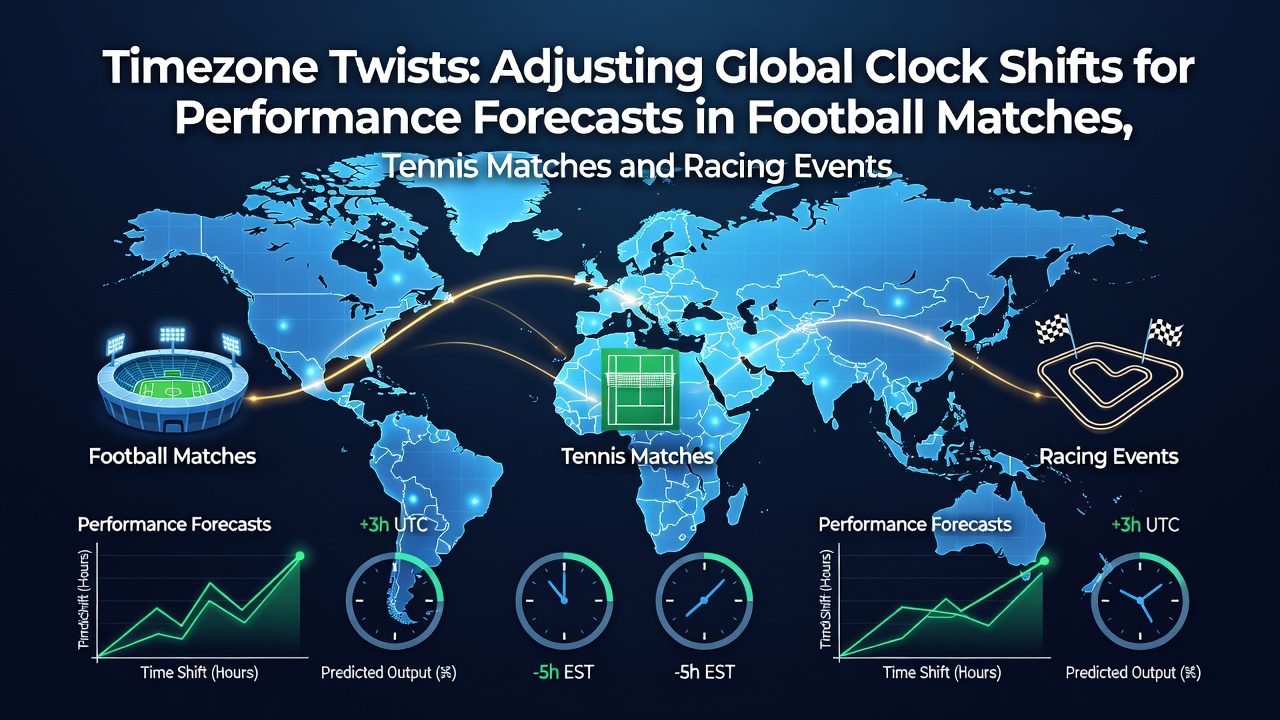
Global sports calendars stretch across multiple time zones each season, and performance forecasts must account for how those shifts affect athletes and animals alike. Football squads traveling from Europe to South America, tennis players moving between Asia and North America, and jockeys flying between Australia and the United Kingdom all encounter circadian disruptions that alter reaction times, endurance and recovery windows. Researchers track these patterns through sleep studies and match data, then build adjustment models that recalibrate expected outputs rather than relying on raw historical averages.
Circadian Basics and Travel Direction
Body clocks run on roughly twenty-four-hour cycles governed by light exposure and melatonin release, yet eastward travel compresses the day while westward journeys extend it. Studies compiled by the Australian Institute of Sport show that eastward flights produce larger deficits in alertness for the first forty-eight hours, whereas westward flights allow gradual realignment through extended daylight. Performance models therefore apply different weighting factors depending on travel vector and number of time zones crossed, rather than treating every long-haul trip as equivalent.
Football Squad Scheduling Across Continents
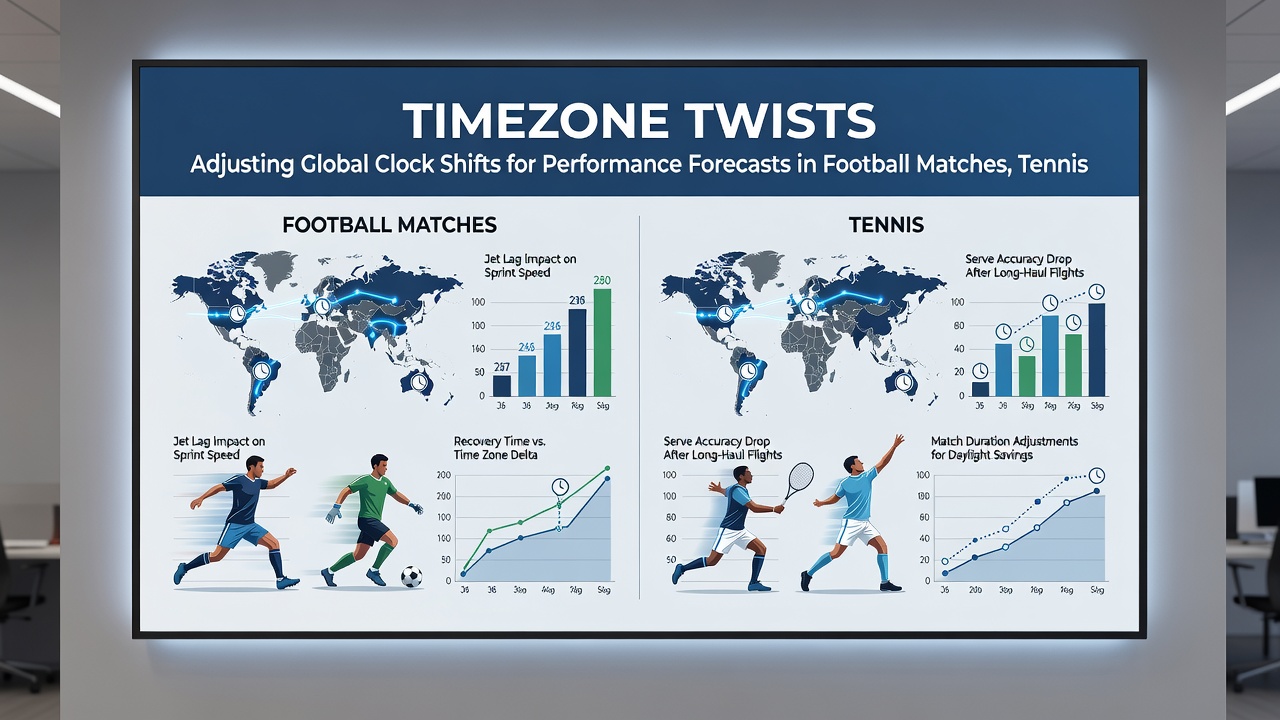
International football fixtures in July 2026 will span the expanded FIFA World Cup across North American venues operating on Pacific, Mountain, Central and Eastern time zones. Teams arriving from Europe or Asia face six to nine hour shifts that compress training windows and alter match kickoff physiology. Analysts adjust goal expectancy calculations by examining prior fixtures where squads crossed similar zones, noting consistent drops in high-intensity running metrics during the opening thirty minutes after eastward travel. Forecast systems integrate these decrements into team strength ratings before generating projected scorelines.
Tennis Tournaments and Daily Recovery Windows
ATP and WTA calendars rotate through Australia, the Middle East, Europe and North America within weeks, forcing players to reset sleep cycles repeatedly. Serve percentages and unforced error rates decline measurably when matches occur between 02:00 and 06:00 local body time, according to aggregated court data. Forecasters therefore layer circadian phase estimates onto surface-specific statistics, producing adjusted probabilities for hold percentages that reflect the actual start time rather than venue averages alone. Evening sessions in one city can become morning sessions after a long flight, flipping the advantage between baseline players and big servers depending on individual chronotype.
Racing Jockeys and Equine Schedules
Horse racing calendars move between hemispheres for major events such as the Melbourne Cup and Royal Ascot, requiring jockeys to manage jet lag while horses adapt to new training routines. Heart-rate variability readings taken before races indicate elevated stress markers when animals travel across more than five time zones, yet recovery timelines differ between Thoroughbreds and standardbreds. Performance models incorporate these markers into speed figure adjustments, shifting expected finishing times for entrants whose last start occurred in a distant zone. Stewards publish official race times in local clock format, but forecasters convert those figures into body-clock equivalents before comparing against historical benchmarks.
Building Integrated Forecast Adjustments
Modern prediction frameworks combine flight manifests, hotel check-in logs and wearable sleep data to estimate each participant’s circadian phase on event day. Football models add a travel-fatigue coefficient to expected goal differentials, tennis algorithms recalibrate serve-win probabilities by time-of-day bins, and racing systems modify pace figures according to elapsed recovery hours. These layered adjustments reduce systematic bias in long-term accuracy metrics, particularly during periods when multiple continents host simultaneous major events.
Practical Implementation Steps
Teams begin by mapping each athlete’s or horse’s departure and arrival airports, then calculate cumulative time-zone crossings since the previous start. Next, they reference published research on performance decay curves published by the National Institutes of Health circadian studies to assign numerical penalties or bonuses. Finally, they re-run baseline simulations with the adjusted inputs and compare output distributions against unadjusted versions to quantify the forecast shift. Regular validation against completed events refines the coefficients for future cycles.
Conclusion
Timezone adjustments have become a standard input layer in performance forecasting across football, tennis and racing because the underlying physiological effects are measurable and repeatable. By converting raw statistics into body-clock equivalents and applying directional travel penalties, analysts produce projections that better reflect real-world conditions rather than venue averages alone. Continued collection of sleep and performance data will further tighten these models as calendars grow more geographically dispersed.